Delunalanding

Narrative of Guido De Las Bazares

Narrative of  The voyage made by GUIDO DE LAS BAZARES, to discover ports and bays on the coast of Florida, for the safety of the troops to be sent there, in the name of his Majesty, PHILIP II., King of Spain, under the orders of Don LUIS DE VELASCO, Viceroy of Mexico, 1558. IT was [...]
January 5, 2012
Florida-Map-s640x480

Memoir of Fontaneda (Version 2)

(Translation by Buckingham Smith, 1854) “Very Powerful Lord: Memoir of the things, the shore, and the Indians of Florida, to describe which, none of the many persons who have coasted that country know how to describe it. The Islands of Yucayo and of Ahite fall on one side of the Channel of the Bahama. There [...]
January 5, 2012
ponce-florida

Memoir Of Hernando D’Escalante Fontaneda

On the Country and Ancient Indian Tribes Of FLORIDA 1575 TRANSLATED FROM TERNAUX COMPAN’S FRENCH TRANSLATION FROM THE ORIGINAL MEMOIR IN SPANISH CHAPTER I. MONSEIGNEUR: I HAVE the honor to inform you that Florida and the Lucayan Islands are situate on one side of the Bahama (old) Channel, which passes between Havanna (Cuba) and Florida. But nearer the [...]
January 5, 2012
desoto-ranged-widely-first-meeting_courtesy Fernbank Museum

New evidence of Spanish in Georgia

Conquistador Was Deep in U.S.: “Stunning” Jewelry Find Redraws Route? Ker Than, for National Geographic News, Published November 1, 2011 Under a former Native American village in Georgia, deep inside what’s now the U.S., archaeologists say they’ve found 16th-century jewelry and other Spanish artifacts. The discovery suggests an expedition led by conquistador Hernando de Soto ventured far [...]
November 3, 2011
Rene Goulaine de Laudonniere (c.1529-82) and Chief Athore in front of Ribault''s Column, c.1570

Le Moyne’s Florida Indians

Le Moyne was an artist who created depictions of Florida’s Native Americans at the first European colony in the New World: Fort Caroline in modern-day Jacksonville, Florida. This colony predates St. Augustine in Florida, Jamestown in Virginia and Plymouth in Massachusetts.
September 26, 2011
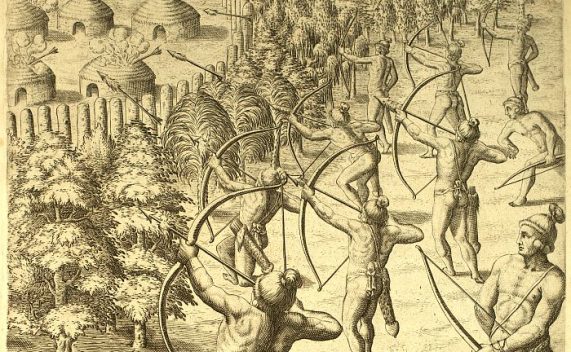
Chief Satouriona prepares for battle

Florida Indians Gallery

On their second voyage to the New World the French arrived  off the coast of Florida on Thursday, June 22, 1564 around three or four o’clock in the afternoon. They landed about thirty leagues south of the St. Johns River. In his own words, Captain Laudonniere states: “Having reconnoitered the river, I landed to talk [...]
September 25, 2011
French in Florida

Narrative of Le Moyne

AN ARTIST WHO ACCOMPANIED THE FRENCH EXPEDITION TO FLORIDA UNDER LAUDONNIERE, 1564. Introduction The Spaniards, having made several disastrous expeditions into Florida, had left it for a time unmolested. The French Protestants, attempting to colonize under Ribaud, built Charlefort at Port Royal in 1562, and Fort Caroline under Laudonniere, at the River May (now St. John’s, Florida), in 1564. [...]
September 24, 2011
Exploration_of_Florida_by_Ribault_and_Laudonniere_1564_by_Le_Moyne_de_Morgues

Jacques Le Moyne

Jacques le Moyne de Morgues (c. 1533–1588) was a French artist and member of Jean Ribault’s expedition to the New World. His depictions of Native American, colonial life and plants are of extraordinary historical importance. Expedition Until well into the 20th century, knowledge of Jacques Le Moyne de Morgues was extremely limited, and largely confined [...]
September 23, 2011
Theodor_de_Bry_self_portrait_1597

Theodor de Bry

Theodorus de Bry (1528 – 27 March 1598) was an engraver, goldsmith and editor who traveled around Europe, starting from the city of Liège (where he was born and grew up), then to Strasbourg, Antwerp, London and Frankfurt, where he settled. Theodorus de Bry created a large number of engraved illustrations for his books. Most [...]
September 22, 2011
oglethorpe-tomochichi

Georgia Before Oglethorpe

You’ve reached a one-stop source for current information about the state of Georgia’s little-known first two centuries after first European contact. My intent in this site is to provide visitors with a wide range of resource materials, historical and otherwise, for research into the almost-forgotten era of Georgia history when American Indians, Spanish missionaries, and English traders briefly shared the land now known as Georgia. It was a turbulent and often tragic era, when plagues and slave raiding destroyed indigenous chiefdoms while Spain and England conducted war by proxy for the Southeastern borderlands. Nevertheless, it was precisely this era which set the stage for the establishment of Georgia by James Edward Oglethorpe in 1733.
September 21, 2011
Page 1 of 212»